3.37 WiFi Piano
3.37.1 Overview
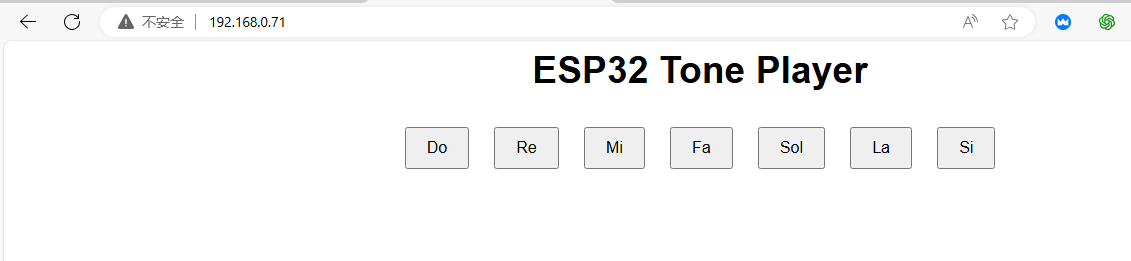
In this project, we set seven buttons to control the speaker to play tones of Do, Re, Mi, Fa, So, La, Si.
3.37.2 Test Code
In Files, open 3-37-wifiWebPiano.py and click  .
.
Code:
'''
 * Filename    : 3-37-wifiWebPiano
 * Thonny      : Thonny 4.1.4
 * Auther      : http//www.keyestudio.com
'''
import network
import socket
import machine
import time

# WiFi connection information
SSID = 'your WiFi name'  # your WiFi name
PASSWORD = 'your WiFi password'  # your WiFi password

# connect to WiFi
def connect_wifi(ssid, password):
    wlan = network.WLAN(network.STA_IF)  # Create WLAN objects using STA mode (client mode)
    wlan.active(True)  # activate WLAN interface
    wlan.connect(ssid, password)  # Connect to the specified WiFi network

    timeout = 10  # Connect timeout duration, in seconds
    while not wlan.isconnected() and timeout > 0:  # If the connection fails and the timeout period does not expire, check the connection status again
        print("Connecting to WiFi...")
        time.sleep(1)
        timeout -= 1

    if not wlan.isconnected():  # If the connection is not successful after timeout, an exception is thrown
        raise Exception("Could not connect to WiFi")

    print('Network config:', wlan.ifconfig())  # Output network configuration (IP address, subnet mask, gateway, and DNS)
    print('Connected to WiFi, IP address:', wlan.ifconfig()[0])  # The IP address of the successful connection is displayed
    return wlan

# create HTML page
def web_page():
    html = """<html>
    <head>
        <title>ESP32 Web Server</title>
        <style>
            body { font-family: Arial, sans-serif; text-align: center; }
            button { padding: 10px 20px; font-size: 16px; margin: 10px; }
        </style>
        <script>
            function playTone(tone) {
                var xhr = new XMLHttpRequest();
                xhr.open("GET", "/play_" + tone, true);
                xhr.send();
            }
        </script>
    </head>
    <body>
        <h1>ESP32 Tone Player</h1>
        <button onclick="playTone('do')">Do</button>
        <button onclick="playTone('re')">Re</button>
        <button onclick="playTone('mi')">Mi</button>
        <button onclick="playTone('fa')">Fa</button>
        <button onclick="playTone('sol')">Sol</button>
        <button onclick="playTone('la')">La</button>
        <button onclick="playTone('si')">Si</button>
    </body>
    </html>"""
    return html  # Return an HTML page with seven keys, one for each note

# Start the Web server
def start_server():
    wlan = connect_wifi(SSID, PASSWORD)  # connect to WiFi
    addr = socket.getaddrinfo('0.0.0.0', 80)[0][-1]  # Obtain the local IP address and port 80
    s = socket.socket()  # Create a socket object
    s.bind(addr)  # Bind sockets to addresses and ports
    s.listen(5)  # Start listening for incoming connections. The maximum number of connections is 5
    print('Listening on', addr)  # Print the address and port on which the server is listening

    while True:
        cl, addr = s.accept()  # Accept a client connection
        print('Client connected from', addr)  # Print the address of the client
        request = cl.recv(1024)  # Receive client requests, up to 1024 bytes
        request = str(request)  # Convert the request to a string
        print('Content = %s' % request)  # Print request content

        response = web_page()  # Generate HTML response

        # Check the request path and play the corresponding note
        if '/play_do' in request:
            play_tone('do')
        elif '/play_re' in request:
            play_tone('re')
        elif '/play_mi' in request:
            play_tone('mi')
        elif '/play_fa' in request:
            play_tone('fa')
        elif '/play_sol' in request:
            play_tone('sol')
        elif '/play_la' in request:
            play_tone('la')
        elif '/play_si' in request:
            play_tone('si')

        cl.send('HTTP/1.1 200 OK\n')
        cl.send('Content-Type: text/html\n')
        cl.send('Connection: close\n\n')
        cl.sendall(response)
        cl.close()  # Close the client connection

# play tone
def play_tone(tone):
    tones = {
        'do': 261.63,
        're': 293.66,
        'mi': 329.63,
        'fa': 349.23,
        'sol': 392.00,
        'la': 440.00,
        'si': 493.88
    }
    frequency = tones.get(tone, 0)
    if frequency > 0:
        pwm = machine.PWM(machine.Pin(32))  # Output PWM signal using GPIO32 pin
        pwm.freq(int(frequency))
        pwm.duty(512)  # Set the duty cycle to 50%
        time.sleep_ms(200)  # play tone to 1s
        pwm.deinit()  # turn off PWM

# run server
try:
    start_server()  # Try starting the Web server
except Exception as e:
    print('Failed to start server:', e)  # If the startup fails, an error message is displayed
    machine.reset()  # Restart the device to try to reconnect
Result:
Upload the code, and the OLED shows the IP address after connecting to wifi.
Connect your computer/mobile phone and ESP32 to the same wifi, and you can access the IP address to see the control page through your device.